Showing posts with label World War Two. Show all posts

Alan Moorehead: ECLIPSE (Fighting in Normandy - 1944)

The following excerpts are taken from Alan Moorehead's Eclipse: An Eyewitness Account of the Invasion of Europe first published in 1945, a year after the invasion..

THE CAEN-CHERBOURG BATTLES

[June 6th, the day of the landing, General Jodl ordered from Hitler's headquarters that the Allied bridgehead must be 'cleaned up by midnight.' He was told that this was impossible.]


ROMMEL by the middle of June had taken his decision. Or rather the decision began to be forced on him, partly by his own imperious aggressiveness and partly by the dreams of Hitler. The Allies had won the first 'battle of the beaches.' Well and good. They could still be driven off. They could be contained in the narrow bridgehead. They could be continually harassed and attacked. Then at the first sign of weakness the panzers would make their drive through to the sea. The battle of France was going to be fought in Normandy. And the order was: 'Attack. Keep on attacking.'

It was a policy the end of which no one could see, a bull-at-a-gate policy, a short range policy, a gambler's policy that might eventually suck up every German reserve in France. And it was the policy which we could most nearly have wished for. There were still two strong German armies in northern France; the Fifteenth, north of the Seine, and the Seventh, grouped round the bridgehead. In addition there were still the forces in the south. Even at this early date the Germans decided to abandon southern France. All troops down there which were capable of movement were directed northward on to the bridgehead. At the same time several panzer divisions were brought across from Russia, and Rommel began to milk the Fifteenth Army. Bit by bit the reinforcements were brought up to the line in Normandy and out directly into battle. A series of chiselling attacks were developed along the line; principally around Caen.

This is the point at which the flying bomb enters the story. The launching sites were established north of the Seine, largely in the area between Amiens and Dunkirk. They were designed to destroy London. It was also hoped that they would break up the invasion by smashing the embarkation ports in southern England. But the programme for the flying bomb was much delayed. First there had been the fantastically lucky and successful raid by the RAF on the experimental station at Peenemunde, when so many of the German scientists had been killed. Then when some two hundred launching sites had been established the RAF had blotted them out. The opening barrage of flying bombs, which was planned for the autumn of 1943, was only ready to come operation on a limited scale in the summer of 1944: nine months late.

With some reason Germany placed tremendous hopes in the flying bomb. Vast underground factories were at work. There was a reasonable chance that by October 1944 they would be able to increase by five times the number of missiles in their original barrage. One can imagine that Rommel was therefore instructed with some urgency that the launching sites north of the Seine were to be protected at all costs. It was reasonable to suppose that the Allies might attempt another landing in the Calais area in order to silence the flying bomb. How far then could Rommel milk the Calais garrison, the Fifteenth Army, in order to reinforce his troops in Normandy? He needed the troops badly at the bridgehead. He was running round the outside of a perimeter, while the Allies sat compactly inside. Given the whole of the Fifteenth Army he might smash the invasion, or at least contain it until the rains came and he had thrown up a defensive line. But could he take the risk of entirely denuding the flying bomb sites of their garrison?

In the end it was a compromise. He took divisions away from the Fifteenth Army one by one. As the German position round the bridgehead became more and more critical he accelerated the process. At length only a skeleton army remained north of the Seine. Some forty divisions were committed to the Normandy battle, and when they were outmaneuvered and beaten there was nothing left in all France; not even enough men to defend the flying bomb sites for a few weeks.

The whole battle of Normandy becomes clear if this point is understood; the fact that one by one the German divisions were lured on to the Allied lines round the bridgehead, and there cut up one by one. Had they all been committed together the Allies might well have been contained in Normandy for another six months or a year. It might have been another, larger Anzio. Alternatively, had Rommel abandoned the Normandy battle in June, and withdrawn his forces to stand on the Seine or even back on the Rhine, the war might have been still further prolonged. As it was, he suited our purposes perfectly. ...


Hermione Ranfurly: War Diaries 1939-45

Hermione, Countess of Ranfurly (1913 - 2001)


At the outbreak of the Second World War Hermione Ranfurly's husband, Second Lieutenant Dan Ranfurly, was posted to Palestine and she followed him to be near him. She was 26-years old at the time. I have taken the following passages from her wartime diaries To War With Whitaker, published in 1994 when she was eighty-years old. 


~  ~  ~


Since I was about five years old I have kept a diary. Though I am now eighty, most of these have survived my many adventures and travels and sometimes I glance at them to remember with laughter.

Growing up is like entering a jungle where some of the larger creatures look alarming and possible man-eaters; and most of the smaller ones - like insects - go unnoticed. As one grows up the jungle gets denser and so, most likely, do you.

But now I am old and in the Departure Lounge - though certainly still growing up - I look back with amusement at how 'cock-sure' I became and how often wrong; so many of those creatures who, at first, looked big and fierce became my life-long friends; so many 'insects' turned out to be brilliant, fascinating and kind companions.

My diaries, written mostly at night and always in haste, in nurseries, school rooms, cars, boats,  aeroplanes and sometimes in loos, expose how we all arrive, helpless,  innocent and ignorant; and then, as we step gingerly into the jungle, show how afraid, selfish, show-off and silly we often are. Mine also prove how lucky I have always been. Most of the creatures in my jungle have been extra special.

Two friends who helped me through thick and thin I never met: Alexander the Great, who said, 'One must live every day as if it were one's last, and as if one would live for ever, both at the same time,' and Oscar Wild, who said, 'All of us are standing in the gutter but a few of us are looking at the stars.' These two remarks should get anyone through their jungle.

Then, of course, there was Dan; forever the best human being I'll ever know.

I have only one regret: that soon the diaries must stop and no longer record - with laughter - what happened next. This is an account of my life during the six years of World War II.


*  *  *


3 September 1939
Melton Mowbray, Leicestershire

Two days ago we left Torridon. It seems an age. As we stacked our guns, golf-clubs and fishing rods into the back seat of our Buick, fear pinched my hear, those are the toys of yesterday I thought; they belong to another world. General Laycock, Dan [Dan Ranfurly, Hermion's husband] and I sat in front. We hardly spoke. No doubt the General was thinking of his sons, Bob, Peter and Michael, who will al have to go to the war. Questions teemed through my mind; where will Dan's Yeomanry, the Notts Sherwood Rangers, go? Will I be able to see him? Mummy, ill in hospital in Switzerland - should I fetch her back to England? And Whitaker [ our cook-butler - perhaps he is too old to be a soldier? It was raining. The windscreen wiper ticked to and fro' and it seemed as if each swipe brought a new and more horrifying thought to me. We had started on a journey - but to where? And for how long?

We sent a telegram from Inverness to our flat in London and drove on to Edinburgh where we were surprised to find the street lamps out. All night we drove slowly, through thick fog. It was hard to see without headlights. None of us slept.

We dropped the General at his house, Wiseton, near Doncaster, where we ate a hurried breakfast and then drove on to London. Whitaker and Mrs Sparrow, our charlady, were waiting for us and a telegram from Dan's Yeomanry saying he must report immediately at Redford in Nottinghamshire. After reading this Dan asked Whitaker if he would like to go with him. The old fatty looked over the top of his spectacles and said, 'To the War, my Lord? Very good, my Lord.' Then we started to pack.

Short and stout, his huge face much creased from smiling, Whitaker has many abilities - all self-taught - but I just can't imagine him going to war on a horse. [The Notts Sherwood Rangers Yeomanry was part of a Cavalry Division.] ...

Thousands of children are being evacuated from London to the country. They, and their parents, must feel as desolate as me.


10 January, 1940

A Farmhouse in Lincolnshire

Nancy Yarborough has organised a canteen at Brocklesby Station for the Sherwood Rangers, who are leaving in batches all this week. I bicycled over to help her. We doled out tea and buns on a long trestle table and watched horses being loaded on to the train - some of them were terrified and took ages. Straw had been laid down everywhere to prevent the horses from slipping on the icy roads and platform. There are about 1000 horses to be moved.
It is bitterly cold - the newspapers say 'It's the coldest snap in the country since 1815, the year of Waterloo.'


4 March, 1940
Rehovoth, Palestine

I am staying in Rona Trotter's rented, unfurnished bungalow on the edge of Rehovoth alongside an orange grove which smells wonderful by day but seems creepy after dark. With camp beds, orange boxes, and a table, two chairs and some blankets lent by the Royal Scots Greys' wives who live nearby, we are quite comfortable. Dan and Henry Trotter are camped at Latrun some distance away. They can come and see us on their two half-days off a week.
The worst of the Troubles in Palestine are supposed to be over but tensions still exist. Rona and I have been warned not to stray off main roads or go out after dark. There is still risk of roads being mined - rape and murder are not unusual. Even soldiers may go out at night only in pairs. Rona has been given a revolver and we are to have shooting lessons in a quarry.


20 May, 1940
Karkur, Palestine

Winston Churchill, now Prime Minister, has made another broadcast. It gave a clear understanding of the gravity of the hour and of his absolute belief in the British people - that we will never surrender. His news was petrifying but I felt braver for his words. Whitaker came up to the bungalow. He, too, had taken courage from Mr Churchill. We had a chat before his bath and he looked over the top of his spectacles and said, 'My Lady, the likes of me believe we will win this war, somehow, someday. I think it will help all our "hesprits du corpses" if you and His Lordship gave a Ball in this bungalow - just like they did before Waterloo." I agreed. When he'd gone back to camp, I locked the doors, pulled the curtains and wept till I fell asleep.


3 November, 1940
Cairo, Egypt

... Orde Wingate telephoned me and asked me to dine with him tonight in his flat. When I arrived he said cheerfully, 'Goodness you are unpopular.'  He explained he got it all taped at GHQ when, just as he was leaving, he was stopped and told there is an order out that no military unit could employ me. He went straight to the Deputy Adjutant General's office where, after an argument, he was told that if he took me to Abyssinia it must be on the understanding that I could not come back to the Middle East.
I explained to Wingate that i'd be foolish to leave neutral territory. He argued that this offer was my only hope of getting a job. I still refused to go but promised that, if I were forced out again, I would join him and try to help but still only on the proviso that when his mission had succeeded he'd get me back into the Middle East, by parachute or whatever. ... I like, and admire, Wingate and feel sure he'll win his little war.  


15 July, 1941
In the train

When I crossed the canal at Kantara and heard the frogs croaking I felt, suddenly, desolate. Palestine will be different this time. Dan is in prison in Italy; Tobby is dead; the Sherwood Foresters are besieged in Tobruk; and Whitaker is left behind in Cairo ... As the train puffed its way north I felt increasingly afraid lest, from panic over my job in Cairo, I'd made a huge mistake.


18 November, 1941
Jerusalem

We have attacked in the Desert. Ironic to be fighting for territory we occupied last year. I hate to think of so many friends struggling down there in the dust.


21 November, 1941
Jerusalem

Bob Leycock's Commandos have raided Rommel's headquarters and it is rumoured that Geoffrey Keyes was killed and Bob is missing. By ill luck Rommel was away and so escaped capture or worse. Other news from the Desert is good so far. It must be a thrilling moment for the garrison in Tobruk.
Cables keep coming from anxious wives and mothers in England asking for news of their men, but, of course, we know little about individuals. In Cairo I was better informed. It's difficult to find time and money to cope with these sad enquiries - telegrams are so expensive.


25 November, 1941
Jerusalem

A letter has come from Dan dated May 10th, written two days after he arrived at Sulmona POW camp in southern Italy. He wrote they had a terrible journey back across North Africa to Tripoli. Nearly all the prisoners had dysentery. He found my telegram waiting for him at Sulmona - forwarded by the Red Cross in Geneva. He wants cigarettes, chocolate, books, tinned butter and a shaving brush. He may only send one letter of eighteen lines each week ... My poor Dan ...


9 July, 1942
Jerusalem

News from Egypt seems a little more reassuring. In Jerusalem emergency preparations are being hurried on. Civilians drill on the golf course.
Lady MacMichael went over to tea with some of the evacuees from Cairo. They are billeted in two convents in Bethlehem  - two thousand of them. 


7 December, 1942
Cairo - Baghdad

I got up at 3.30 a.m. after a chequered night, having been disturbed by the man in the next room quarrelling with his wife, or somebody else's; every time I knocked on the wall he called, 'Come in.' I was collected from the hotel by a lorry, climbed into the back of it with my suitcase and typewriter and drove with a lot of soldiers to the aerodrome. It was dark but peasants were already driving their overloaded donkeys into the markets; they made a soft cloppety noise as they passed.
We flew off before daybreak - twenty passengers packed on narrow steel benches; we had to sit bolt upright because of the joints in the fuselage. When the sun came up over the Sinai Desert, Lord Moyne, who was sitting opposite me, fished  some gadgets out of his pocket and began calculating our height and speed; from time to time he compared notes with the pilot. We landed at Lydda to refuel so I got out to stretch my legs. It had been raining and the earth smelt good. 'Wonderful thing, air travel,' said my neighbour; 'from Cairo to Palestine in a couple of hours - it took Moses forty years.'  Flying over the long stretch of desert to Habbanyeh I began fussing  about my new job; will I ever learn military terms and initials? Will my shorthand be fast enough? Where shall I live? So many people warned me that Baghdad is a horrible place - famous only for boils. ...


16 May, 1943
Cairo


Last week all Axis forces in Tunisia surrendered. The struggle for North Africa is ended. It will not be long now before we invade Hitler's fortress, Europe. Bill Stirling and I dined together and drank to all prisoners of war, this news must be most precious to them if they learn of it.
The RAF have made a thrilling raid on the Mohne and Eder Dams in Germany.


13 January, 1944
Cairo

We have said goodbye to all our friends in Cairo, the Sofragis, baggage men, our Italian dressmaker and her fat pug, the King of Greece in his villa on the Nile, etc. Daphne and I are packed and ready to go to Algiers. For years I have lived close to the Desert but never seen it. Tomorrow I shall see the stage of all those adventures, tragedies, retreats, sieges and victories. The land where all those people I knew and listened to, lived and fought and perhaps died.


11 October, 1944
Caserta

The Poles in Italy are keeping two weeks' mourning for Warsaw. The fate of Poland, and particularly Warsaw where most of their families are, has been a deep agony for them. For once neither their gaiety nor their elegant manners could hide it. It is comforting to remember that though Catherine the Great of Russia used the throne of Poland as a lavatory seat - she died on it.


14 November, 1944

Caserta

Yesterday was my thirty-first birthday. It was a warm sunny morning and Raphaeli carried his canaries out into the garden. A puff of cloud or white smoke hung over Vesuvius. On the way to work Olroyd told me about a gang of British and American deserters and some Italians, who have been doing armed hold-ups on the main roads. Sometimes they are dressed as military police and travel in a jeep. They halt cars, like a check post, and then rob the owners. ...


31 December, 1944
London

The last day of 1944 - 366 days of terrible fighting on land, sea and air - and of unforgettable heroism and tragedy. It seems unbelievable that for five and a quarter years we've all left our homes and happiness behind to concentrate on conflict. We can never get those years back - or all the friends we've lost. Pray God the New Year will bring victory and peace so we can all have private lives again.


3 February, 1945

Caserta

... Randolph Churchill paid me a visit, full of gossip from Malta. 'The Prime Minister had received a telegram from Stalin at Yalta saying "Here I am. Where are you?" The Prime Minister's valet had left Churchill's handkerchiefs behind which caused a major rumpus ... '  Randolph always refers to his father as the Prime Minister or Churchil, and I always interrupt and say, 'Oh, you mean Daddy.' Randolph is so often rude to high and low that we enjoy teasing him. For all his nuisance value and rudeness I am fond of Randolph - he reminds me of nursery days when often I was disgracefully rude to Nannie. He's never grown up.


13 April, 1945
Caserta

... [during breakfast] I reached for my newsheet. I read it from start to finish and then folded it up and put it in my pocket.


VOLUME III, NO. 131SIGNAL CORPS BULLETINFRIDAY, 13 APR. 1945
ALLIED FORCE HEADQUARTERSOFFICE OF THE CHIEF SIGNAL OFFICER
WASHINGTON: THE WHITE HOUSE ANNOUNCED LATE YESTERDAY THAT PRESIDENT FRANKLIN DELANO ROOSEVELT HAD DIED AT 3.35 P.M. CENTRAL WAR TIME AT WARM SPRINGS, GA., OF GENERAL HEMORRHAGE. HARRY S. TRUMAN WAS SWORN IN AND BECAME THE 33RD PRESIDENT OF THE UNITED STATES WHEN HE REPEATED THE OATH BEFORE CHIEF JUSTICE HARLAN STONE AT 5.09 EWT.

26 May, 1945
London

On Thursday I put on my prettiest clothes and arrived at King's Cross Station an hour early for Dan's train. 'When the train glides in,' I thought, 'it will be the end of all our misery - the beginning of living happily for ever after ... '
I saw him a long way down the platform. I stood and watched him, just like I did a long time ago, on sand, at Rehovoth. Heaven ... is being together.


                     

George Orwell: About Jewish women

From War-time Diary; 1940


George Orwell
(25 June 1903 - 21 January 1950)
The other night examined the crowds sheltering in Chancery Lane, Oxford Circus and Baker Street. Not all Jews, but, I think, a higher proportion of Jews than one would normally see in a crowd of this size. What is bad about Jews is that they are not only conspicuous, but go out of their way to make themselves so. A fearful Jewish woman, a regular comic paper cartoon of a Jewess, fought her way off a train at Oxford Circus, landing blows on anyone who stood in her way. It took me back to old days on the Paris Metro.

Surprised to find that D, who is distinctly Left in his views, is inclined to share the current feeling against the Jews. He says that Jews in business circles turning pro-Hitler, or preparing to do so. This sounds almost incredible, but according to D they will always admire anyone who kicks them. What I do feel is that any Jew, i.e. European Jew, would prefer Hitler's kind of social system to ours, if it were not that he happens to persecute them. Ditto with almost any Central European, e.g. the refugees. They make use of England as a sanctuary, but they cannot help feeling the profoundest contempt for it. You can see this in their eyes, even when they don't say it outright. The fact is that the insular outlook and the continental outlook are completely incompatible.


~  ~  ~


To see other posts in this blog use the search box at the top or the list of 'Labels' on the right.


Harold Nicolson: End-of-year excerpts from Diaries & Letters: 1939-45

)

Harold Nicolson (1886 - 1968)

A few end-of-year excerpts from Diaries & Letters: 1939 - 45

Diary: 31 December, 1939

Cyril Joad* expounds pacifism after dinner. His line is that the ordinary person in England would be less unhappy after a Nazi victory than if he or she lost their sons, lovers or husbands. He thinks only of the greatest unhappiness of the greatest number, and accuses me of national and spiritual pride. It is a pleasure talking to him. He stirs up the mind. He is extremely imaginative about physical pain, and the picture of young men being gored by bayonets is so terrible to him that he would prefer sacrificing liberty to prevent it happening.

I do not stay to watch the New Year in or the Old Year out. I write this diary at 11.45 and shall not wait. The old year is foul and the new year terrifying. I think, as I go to bed, of Nigel and Ben, Ben and Nigel. How stupid life is. Not evil, only stupid. What shall I have to record this time net year?

* The author and philosopher. He was an old friend of H.N., with whom he had been associated during the days of the New Party in 1931. He was a leading pacifist at the beginning of the Second World War as he was in the First. 


Letter from H.N. to V.S.W.:  31 December, 1940
(In the train from Bristol to Cardiff)

I have found a new pleasure in life - travelling with a Private Secretary. One just walks about in a fur coat and things get done. Moreover, he keeps the purse and gives such tips as I should never dare to give. But it is at him the porters scowl, not me. I just walk away and gaze at the show-cases in the hall. 

I lunched with the Regional Commissioner yesterday to meet Alexander, the C. in C. of Southern Command. He thinks the Battle of England has already began - Coventry, Southampton, Bristol, the City. They will burn and destroy them one by one. 'Archie Wavell', he says, 'mops up 40,000 Libyans and we claim a victory. In two hours the Germans destroy 500 years of  our history.' I do think we are going through a hellish time.


Diary: 31 December, 1941

Read Rebecca West's book about Yugoslavia.*  Feed the famished swans. We stay up late listening to the wireless and hearing Maisky, Wellington Koo and John Winant exchanging polite messages. Then there is a Scottish service, in the middle of which Big Ben strikes and 1941 is finished. Not a year on which |I shall look back with any pleasure. I shall say no more about it than that. It has been a sad and horrible year.

* Black Lamb and Grey Falcon 


Diary: 31 December, 1942

Our present worry is (a) the U-boat campaign. It is very serious indeed. We can lose the war by this; (b) the badness of our Army. The cream of our officers and men have been drained off by the R.A.F. and the Commandos. What remains is pretty poor. With good troops we ought to have brought off the dash to Tunis.   As it is ...

I go down to the House to fire watch. I sit in the map-room feeling pretty glum. I hear Big Ben strike out the old year. There are distant shouts of Auld Lang Syne, sung with an American accent. Then the snoring in my dormitory resumes its sway.


Natalia Ginsburg: All Our Yesterdays

The following is an excerpt from Natalia Ginsburg's All Our Yesterdays.

Natalia Ginsburg (14 July 1916 - 7 October 1991)
Signora Maria related what she had heard in the shops and from the music master she still met sometimes on the road by the river. The Germans were sprinkling a kind of powder that made people stupid. The Allies were breathing in this powder and were fighting half asleep. And the French generals were accepting gold coins from the Germans to make wrong moves. And the Germans were dressing up as French peasants and fishermen and were cutting the telegraph wires and poisoning the rivers.And the roads of France were full of refugees, women running away with their children, and the children got lost and the Germans caught them and sent them off to their laboratories, where they used them for scientific  experiments like frogs or rabbits. Emanuele put his hands over his ears and besought them for goodness' sake to make her stop talking, his nerves were all to pieces and he couldn't control himself, one day perhaps he would strangle Signora Maria. Emanuele disliked the Belgians, the French, the English, the Russians who had allied themselves with the Germans, he limped up and down the room and kicked at the furniture. He disliked Signora Maria who was spreading panic. In his own home he also had Franz spreading panic. He wandered about like a ghost and said that the Germans by advancing in France would overflow into Italy. Emanuele told him he was behaving as though the Germans were already in Italy; but perhaps Mussolini was not sticking by the Germans. Franz said he was not afraid of Mussolini, he was only afraid of the Germans, if he found himself face to face with German soldiers he would go mad. At night he came to Emanuele's room and sat on his bed, and made him repeat that the Maginot Line was impenetrable. But the Germans went on penetrating it. One night he woke Emanuele to tell him that not only was his mother Jewish but his father too, he was completely Jewish and it was well known what the Germans were doing to the Jews, if the Germans came down into Italy the only thing for him to do would be to put a bullet through his head. So many times he had been on the point of going to America but he liked Italy too much, in Italy he felt he was safe even though for some time now there had been laws against the Jews, all you did was to pay a little and the police left you alone. But now he felt the Germans altogether too near, there they were in France behind the mountains and all they had to do was cross the mountains to get to where he was.
~  ~  ~


To see other posts in this blog use the search box at the top or the list of 'Labels' on the right.


George Orwell: Review of Mein Kampf

The following is an excerpt from George Orwell's review of Hitler's Mein Kampf.


George Orwell
(25 June 1903 - 21 January 1950)
... I should like to to put it on record that I have never been able to dislike Hitler. Ever since he came to power - till then, like nearly everyone, I had been deceived into thinking that he did not matter- I have reflected that I would certainly kill him if I could get within reach of him, but that I could feel no personal animosity. The fact is that there is something deeply appealing about him. One feels it again when one sees his photographs - and I recommend especially the photograph at the beginning of Hurst and Blackett's edition, which shows Hitler in his early Brownshirt days. It is a pathetic, dog-like face, the face of a man suffering under intolerable wrongs. In a rather more manly way it reproduces the  expression of innumerable pictures of Christ crucified, and there is little doubt that there is how Hitler sees himself. The initial, personal cause of his grievance against the universe can only be guessed at, but at any rate the grievance is there. He is the martyr, the victim, Prometheus chained to the rock, the self-sacrificing hero  who fights single-handed against impossible odds. If he were killing a mouse he would know how to make it seem like a dragon. One feels, as with Napoleon, that he is fighting against destiny, that he can't win, and yet that he somehow deserves to. The attraction of such a pose is of course enormous, half the films that one sees turn upon some such theme.

Also he has grasped the falsity of the hedonistic attitude to life. Nearly all western thought since the last war, certainly all "progressive" thought, has assumed tacitly that human beings desire nothing beyond ease, security and avoidance of pain. In such a view of life there is no room, for instance, for patriotism and the military virtues. The Socialist who finds his children playing with soldiers is usually upset, but he is never able to think of a substitute for the tin soldiers, tin pacifists somehow won't do. Hitler, because in his joyless mind he feels it with exceptional strength, knows that human beings don't only want comfort, safety, short working hours, hygiene, birth-control and, in general, common sense, they also, at least intermittently, want struggle and self-sacrifice, not to mention drums, flags and loyalty-parades. However they may be as economic theories, Fascism and Nazism are psychologically far sounder than any hedonistic conception of life. The same is probably true of Stalin's militarized version of Socialism. All three of the great dictators have enhanced their power by imposing intolerable burdens on their peoples. Whereas Socialism, and even capitalism in a more grudging way, have said to people "I offer you a good time," Hitler has said to them "I offer you struggle, danger and death," and as a result a whole nation flings itself at his feet. Perhaps later on they will get sick of it and change their minds, as at the end of the last war. After a few years of slaughter and starvation "Greatest happiness of the greatest number" is a good slogan, but at this moment "Better an end with horror than a horror without end" is a winner. Now that we are fighting against the man who coined it, we ought not to underestimate it emotional appeal.
~  ~  ~          

To see other posts in this blog use the search box at the top or the list of 'Labels' on the right.


William Shirer: The first day of World War Two

William Shirer (February 23, 1904 - December 28, 1993)
From Berlin Diary

Berlin, September 3

Hitler's "counter attack" on Poland has on this Sabbath day become a world war! To record the date: September 3, 1939. The time: eleven a.m. At nine o'clock this morning Sir Nevile Henderson called on the German Foreign Minister and handed him a note giving Germany until eleven o'clock to accept the British demand that Germany withdraw her troops from Poland. He returned to the Wilhemstrasse shortly after eleven and was handed the German reply in the form of a memorandum. The extras are out on the streets now. The newsboys are giving them away. The D.A.Z. here. Its headlines:


BRITISH ULTIMATUM TURNED DOWN
ENGLAND DECLARES A STATE OF WAR
WITH GERMANY
BRITISH NOTE DEMANDS WITHDRAWAL
OF OUR TROOPS IN THE EAST
THE FUHRER LEAVING TODAY FOR THE FRONT

A typical headline over the official account:

GERMAN MEMORANDUM PROVES
ENGLAND'S GUILT.

I was standing in the Wilhelmplatz about noon when the loud-speakers suddenly announced that England had declared herself at war with Germany. Some 250 people were standing there in the sun. They listened attentively to the announcement. When it was finished, there was not a murmur. They just stood there as they were before. Stunned. The people cannot realize yet that Hitler has led them into a world war. No issue has been created for them yet, though as this day wears on,it is plain that "Albion's perfidy" will become the issue as it did in 1914. In Mein Kampf Hitler says the greatest mistake the Kaiser made was to fight England, and Germany must never repeat that mistake.

*  *  *


To see other posts in this blog use the search box at the top or the list of 'Labels' on the right.


Martha Gellhorn: The Carpathian Lancers (Italy, July 1944)

Martha Gellhorn (8 November, 1908 - 15 February, 1998)
This field grew huge dead cattle. They lay with their legs pointing up, and their open eyes were milky and enormous, and the air stank of their swollen bodies. We could not tell what had killed them because we were driving too fast through a long tunnel of dust which was the road. Aside from the hideous dead animals everything looked lovely, with the Adriatic a flat turquoise blue and the sky a flat china blue and the neat green hilly country of the Marche ahead. The Major drove as usual like mad. There was plenty of dust in Italy all the time, but when he drove a roaring surf of dust beat out behind us.

We were going up to have a look at the front before lunch.

We came to a village where the armored cars of the Third Squadron were stationed. They stood in the narrow side streets and were covered with leafy branches, had a pair of German steel helmets over each set of headlights, and flew the small red and blue pennant of the Carpathian Lancers from their radio antennae. Poppi, who commanded this squadron, leaned out the window of a house by the road and invited us in. The infantry was moving forward very slowly in trucks. All the infantry had dusty white faces, as if they had decided on some new sort of masquerade, using flour for make-up. They looked hot and unenthusiastic.

Poppi is more than six feet tall, exaggeratedly blond, about twenty-five years old, with bright-blue eyes and a funny husky voice. I wouldn't have thought that he was a Pole but I have now given up thinking that people look like Poles or don't look like Poles. The Poles cannot be classified, which is one of their chief charms. ...

... The Germans were beyond a ruined medieval tower which was our farthest advance position. They held somewhere in the hills and in whatever farmhouses they thought useful. The tower was being shelled. The Germans had anti-tank guns placed in farm-houses where they dominated the roads. The Lancers' armored cars were intended for was in the Western Desert; they could not operate across country, so they had to stick to the roads. The Germans waited and shot at them point blank. It was like roulette; you either won or you got burned inside your car or maybe you crawled out in time. This went on during the daytime, and the infantry pushed ahead a little, and our artillery shelled the German positions, and at night usually the germans retreated a few kilometers further north. It was a tiny war at the moments, though people got killed in tiny wars also. ...

... the Carpathian Lancers had been the spearhead of the Polish Cores in a spectacular advance of two hundred miles up the Adriaticcoast; and nobody was feeling violently energetic now, a few days after the capture of the port of Ancona. It was too soon for another big Polish drive, and the Lancers and the Germans were only prodding each other, while the Polish Corps reorganized for the next push.

We roared away in our private dust storm. The major was disappointed in the tour. "Nossing," he said, "Tres ennuyeux pour vous. Sie haben nichts gesehen."  The use of three scrambled languages was our regular communication system. Everyone understood everyone else perfectly.

Since the war had so delightfully stopped and since it was beautiful weather and since Second Squadron was in reserve near us and doing nothing in particular, we decided to go swimming. There was a slight snag because no one had had time to investigate the beach and the approaches to the beach for mines; but as the Poles said, if you spent your life always considering mines it would be quite impossible. So we climbed over a German-destroyed railway bridge, climbing as delicately as if we were Balinese dancers, stepped softly on the torn-up wooden ties and jumped prudently down the embankment and then walked very very lightly along a dusty road to the shore. Andrew, who is a second lieutenant and commands a platoon of armored cars, and I did this noble work of reconnaissance. We decided to walk side by side or closely following each other, on the grounds that it would not be fair for just one of us to explode. There were no mines, at least we did not step on any and there was the warm pale sea and a beach of smooth white pebbles.


Robert Capa: D-Day (a memoir)

Robert Capa (October 22, 1913 - May 25, 1954)
Slightly Out of Focus is Capa's memoir of World War Two. The following excerpt describes the crossing to Normandy on D-Day with the first wave of the Allied invasion fleet on 6 June 1944.


*  *  *

Once a year, usually sometime in April, every self respecting Jewish family celebrates Passover, the Jewish Thanksgiving. The Passover celebration proceeds along the well-known lines of Thanksgiving, the only difference between the two being the Passover feast has everything and turkey too, and that the children of the very old world get even more sick than those of the very new world.

When dinner is irrevocably over, father loosens his belt and lights a five-cent cigar. At the crucial moment the youngest of the sons - I have been doing it for years - steps up and addresses his father  in solemn Hebrew. He asks, "What makes this day different from from all other days?" The father, with great relish and gusto, tells the story of how, many thousands of years ago in Egypt, the angel of destruction passed over the firstborn sons of the Chosen People, and how, afterwards, General Moses led them across the Red Sea without getting their feet wet.

The Gentiles and Jews who crossed the English Channel on the sixth of June in the year 1944, landing with very wet feet on the beach in Normandy called "Easy Red," ought to have - once a year, on that day - a Crossover day. Their children, after finishing a couple of cans of C-rations, would ask their father, "What makes this day different from all other days?" The story that I would tell might sound like this:

The men who were condemned to spend that spring on the French beaches were gathered in immense concentration camps on the southeast coast of England. The camps were surrounded by barbed wire, and once you entered the gates you were halfway across the Channel.

Inside, we were being processed for our trip. We had to exchange our legitimate dollar bills and pound notes for invasion francs printed on flimsy paper. We received a list containing hundreds of items which told what the well-dressed visitor would be wearing on the French beaches during the 1944 season. In addition, we received a little book telling us how to treat and address the natives there. There were some useful approaches in French. "Bonjour, monsieur, les amis americains."  That was for addressing the men. "Bonjour, mademoisell, voulez-vous faire une promenade avec moi?"  That was for the girls. The first one meant "Mister, don't shoot me," and the other could mean anything.

There were still other suggestions dealing with the natives of a different country, whom we expected - for certain reasons - to meet in numbers on the beaches. These consisted of convenient German phrases which promised cigarettes, hot baths, and all sorts of comforts, all in exchange for the simple act of unconditional surrender. Indeed, the booklet made promising reading.

Every piece of our clothing had to be gasproofed, waterproofed, and camouflaged in the many various colours of our future landscape. Thus prepared, we were ready for the day called "D."

We were all suffering from that strange sickness known as "amphibia." Being amphibious troops had only one meaning for us; we would have to be unhappy in the water before we could be unhappy on the shore. There were no exceptions. The only character who is amphibious and happy at the same time is the alligator. There were different degrees of "amphibia" and those who were scheduled to be the first to reach the beach had it the worst.

The harbor at Weymouth was having a grand time. Battleships, troopships, freighters, and invasion barges all mingled together. Floating in the air above them was a balloon barrage made up of many hundreds of silver blimps. The prospective tourists to France were sunbathing on the decks of the boats and lazily watching the giant toys that were being hoisted aboard. For the optimists, everything looked like a new secret weapon, especially from a distance.

On my boat, the U.S.S. Chase, the population fell into three categories: the planners, the gamblers, and the writers of last letters. The gamblers were to be found on the upper deck, clustering around a pair of tiny dice and putting thousands of dollars on the blanket. The last-letter writers hid in corners and were putting down beautiful sentences on paper leaving their favorite shotguns to kid brothers and their dough to the family. As for the planners, they were down in the gymnasium in the bottom of the ship, lying on their stomachs around a rubber carpet on which was placed a miniature of every house and tree on the French coast. The platoon leaders picked their way between the rubber villages and looked for protection behind the rubber trees and in the rubber ditches on the mattress.

We also had a tiny model of every ship, and low on the walls were signs giving the names of the beaches and the specific sectors: "Fox Green," "Easy Red," and others, all parts of the "Omaha" beach. The naval commander and his staff had joined the gymnasium and they were pushing the little ships in order to reach the beaches that were painted on the walls. They pushed them around very expertly. In fact, the more I looked at these bemedaled gents playing on the floor, the more I was filled with terrific confidence.

I followed the proceedings on the gymnasium floor with more than polite interest. The U.S.S. Chase was a mother ship which carried many assault barges which it would release ten miles off the French coast. I would have to make up my mind and choose a barge to ride in and a rubber tree to hide behind on the shore. It was like watching a lot of race horses ten minutes before starting time. In five minutes the bests would have to be placed.

On the one hand, the objectives of Company B looked interesting, and to go along with them seemed a pretty safe bet. Then again, I used to know Company E very well and the story I had got with them in Sicily was one of my best in the war. I was about to choose between Company B and E when Colonel Taylor, commander of the 16th Infantry Regiment of the 1st Division, the attacking force, tipped me off that regimental headquarters would follow close behind the first waves of infantry. If I went with him, I wouldn't miss the action, and I'll be a little safer. This sounded like the real favorite - an even-money bet - two to one to be alive in the evening.

If at this point my son should interrupt me, and ask, "What is the difference between the war correspondent and any other man in uniform?" I would say that the war correspondent gets more drinks, more girls, better pay and greater freedom than the soldier, at this stage of the game, having the freedom to choose his spot and being allowed to be a coward and not to be executed for it is his torture. The war correspondent has his stake - his life - in his own hands and he can put it on this horse or that horse, or he cab put it back in his pocket at the very last minute.

I am a gambler. I decided to go with Company E in the first wave.

Once I decided to go in with the first assault troops I began to convince myself that the invasion would be a pushover and that all this talk about an "impregnable west wall" was just German propaganda. I went up on deck and took a good look at the disappearing English coast. The pale green glow of the vanishing island hit my soft spot and I joined the legion of the last-letter-writers. My brother could have my ski boots and my mother could invite someone from England to stay with her. The idea was disgusting, and I never mailed the letter. I folded it up, and stuck it in my breast pocket.

Now I joined the third category. At 2:00 A.M. the ship's loudspeaker broke up our poker game. We placced our money in waterproof money belts and were brutally reminded that the Thing was imminent.

They fixed a gas mask, and inflatable lifebelt, a shovel, and some other gadgets around me, and I placed my very expensive Burberry raincoat over my arm. I was the most elegant invader of them all. Our preinvasion breakfast was served at 3:00 A.M. The mess boys of the U.S.S. Chase wore immaculate white jackets and served hot cakes, sausages, eggs, and coffee with unusual zest and politeness. But the preinvasion stomachs were preoccupied, and most of the noble effort was left on the plates.

At 4:00 A.M. we were assembled on the open deck. The invasion barges were swinging on the cranes, ready to be lowered. Waiting for the first ray of light, the two thousand men stood in perfect silence, whatever they were thinking, it was some kind of prayer.

I too stood very quietly. I was thinking a little bit of everything, of green fields, pink clouds, grazing sheep, all the good times and very much of getting the best pictures of the day. None of us was at all impatient, and we wouldn't have minded standing in the darkness for a very long time. But the sun had no way of knowing that this day was different from all others, and rose on its usual schedule. The first-wavers stumbled into their barges, and - as if on slow-moving elevator - were descended onto the sea. The sea was rough and we were wet before our barge pushed away from the mother ship.It was already clear that General Eisenhower would not lead his people across the Channel with dry feet or dry else.

In no time the men started to puke. But this was a polite as well as a carefully prepared invasion, and little paper bags had been provided for the purpose. Soon the puking hit a new low. I had an idea this would develop into the father and mother of all D-Days.


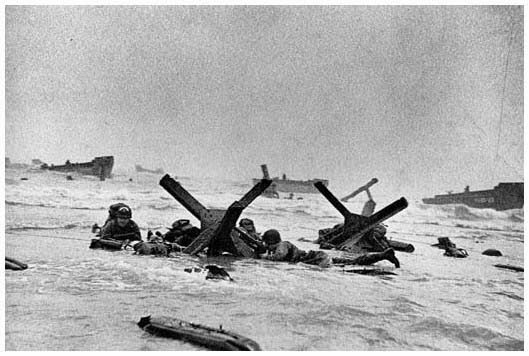
The coast of Normandy was still miles away when the first unmistakable popping reached our listening ears. We ducked down in the puky water in the bottom of the barge and ceased to watch the approaching coastline. The first empty barge, which had already unloaded its troops on the beach, passed us on the way back to the Chase and the Negro boatswain gave us a happy grin and the V sign. It was now light enough to start taking pictures and I brought my first Contax camera out of its waterproof oilskin. The flat bottom of our barge hit the earth of France. The boatswain lowered the steel-covered barge front, and there, between the grotesque designs of steel obstacles sticking out of the water, was a thin line of land covered with smoke - our Europe, the "Easy Red" beach.

My beautiful France looked sordid and uninviting, and a German machine gun, spitting bullets around the barge, fully spoiled my return. The men from my barge waded in the water. Waist deep, with rifles ready to shoot, with the invasion obstacles and the smoking beach in the background - this was good enough for the photographer. I paused for a moment on the gangplank to take my first real picture of the invasion. The boatswain, who was in an understandable hurry to get the hell out of there, mistook my picture-taking attitude for explicable hesitation, and helped me make up my mind with a well-aimed kick in the rear. The water was cold, and the beach still more than a hundred yards away. The bullets tore holes in the water around me, and I made for the nearest steel obstacle.


A soldier got there at the same time, and for a few minutes we shared its cover. He took off the waterproofing of his rifle and began to shoot without much aiming at the smoke-hidden beach. The sound of his rifle gave him enough courage to to move forward and he left the obstacle to me. It was a foot larger now and I felt safe enough to take pictures of the other guys hiding just as I was.
It was still very early and very gray for good pictures, but the gray water and the gray sky made the little men, dodging under the surrealistic designs of Hitler's anti-invasion brain trust, very effective.

I finished my pictures, and the sea was cold in my trousers. Reluctantly, I tried to move away from my steel pole, but the bullets chased me back every time. Fifty yards ahead of me, one of our half-burnt amphibious tanks stuck out of the water and offered me my next cover. I sized up the moment. There was little future for the elegant raincoat heavy on my arm. I dropped it and made for the tank. Between floating bodies I reached it, paused for a few more pictures, and gathered my guts for the last jump to the beach.

Now the Germans played on all their instruments, and I could not find any hole between the shells and bullets that blocked the last twent-five yards to the beach, I just stayed behind my tank, repeating a little sentence from my Spanish Civil War days, "Es una cosa muy seria. Es una cosa muy seria." This is a very serious business.

The tide was coming in and now the water reached the farewell letter to my family in my breast pocket. Behind the human cover of the last two guys, I reached the beach. I threw myself flat and my lips touched the earth of France. I had no desire to kiss it.